Kindergarten in Harburg: The Years from Three to Six, Step by Step
 Arianne Vogt
Kindergarten in Harburg: The Years from Three to Six, Step by Step
Between three and six, your child primarily learns to get along with others, to accomplish things independently, and to embrace new experiences. These are the skills that will carry them through school later. In Hamburg, there are specific dates to keep in mind, such as the presentation interview at four and a half and the decision about preschool.
Briefly explained: In Hamburg, the elementary education phase, commonly referred to as kindergarten, begins on your child's third birthday and lasts until school enrollment. The pedagogical work in Kitas (daycare centers) is guided by the Hamburger Bildungsempfehlungen (Hamburg Educational Recommendations). In the last year before school, the bridging year, you have the choice between preschool in the Kita and a preschool class at a primary school. This guide walks you through these years, from saying goodbye to the nursery to the first day of school in Harburg.
At Three: What Changes When Your Child Enters Elementary Education?
The transition from the nursery feels bigger than many families expect. Your child is now one of the youngest among older children. They learn how to resolve conflicts, how to wait for their turn at lunch, and how to invent a game that three people can play simultaneously. Learning at this age primarily means participating, experimenting, and repeating.
For you, this means: focus less on what your child can "show off" in the afternoon. More important is whether they enjoy going, if they have found trusted caregivers, and if they talk about their day, even if only in fragments. If your child changes facilities or groups, they still need a gentle settling-in period, even at three. You can read how to best support this in our article on settling into Kita.
Formally, something also changes: childcare continues to be covered by the Kita-Gutschein (Kita voucher). For families residing in Harburg, the Bezirksamt Harburg (Harburg District Office) is responsible for this. Our article on the Kita-Gutschein in Harburg explains what you should consider when applying.
At Four: How Does What Your Child Is Learning Become Visible?
At four, children want to have a say. They have opinions about food, excursion destinations, and whether a rain jacket is really necessary. Good Kitas take this seriously. They let children vote, help develop rules, and suggest their own projects. In doing so, children incidentally practice expressing wishes, saying no, and coping with disappointment when the majority decides differently.
To help you understand what happens in daily life, many facilities keep a portfolio for each child. This includes photos of constructions, drawings, and short learning stories. These are small texts in which educators record what your child has discovered or said. Such a folder shows what your child can already do, not what they are still lacking. It also provides a good basis for developmental discussions.
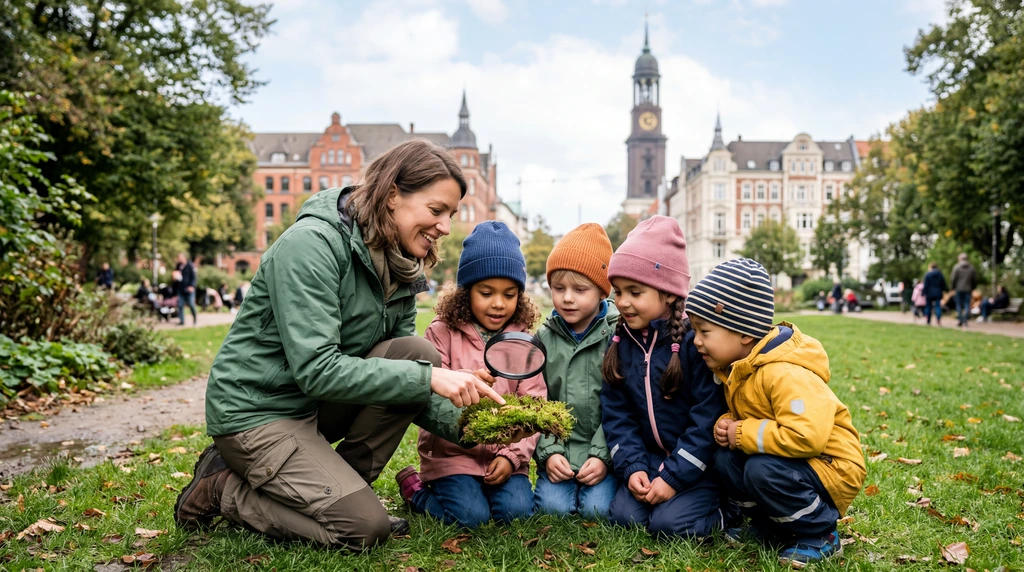
Children also learn a lot outdoors, right in the city. A pile of chestnuts becomes a math problem, a puddle an experiment about depth and splash distance. Around Harburg, excursions to the Harburger Stadtpark, for example, are ideal for this. Crucial is pedagogical support that picks up on questions instead of immediately providing answers.
At Four and a Half: What Happens During the Presentation Procedure?
Approximately one and a half years before school enrollment, the responsible primary school invites you and your child to the Vorstellungsverfahren der Viereinhalbjährigen (presentation procedure for four-and-a-half-year-olds). During this, the school gets an impression of your child's developmental stage. A key focus is on language.
If the school identifies a significant need for language support, attending a preschool class becomes mandatory. This is regulated by § 28a of the Hamburg School Law. In this case, compulsory schooling begins one year earlier. In exceptional cases, your child can instead receive additional language support in their Kita. However, you must apply for this, and the Kita must also be able to provide this support. For all other children, the preschool class remains voluntary. There is no legal entitlement to a place.
Conveniently: during the presentation interview, you can register your child for a preschool class right away if you wish to take this path.
Keep an eye on deadlines: Registration for preschool classes takes place within a fixed period, usually from early November to late January. For the 2026/27 school year, the period was November 5, 2025, to January 23, 2026. You will receive the admission notice at the end of March or early April. The school authority sets the dates anew each year. Therefore, inquire early at your responsible primary school, as places are scarce at popular schools.
At Five: Kita Preschool or Preschool Class – Which Path Suits Your Child?
In the bridging year, similar things are addressed at both learning locations. Your child practices using scissors and pencils, develops a sense of quantities, and learns to distinguish sounds and rhymes. Experts refer to this as phonological awareness. The main difference lies in the setting.
| Question | Preschool in the Kita | Preschool Class at Primary School |
|---|---|---|
| Where does it take place? | In the familiar facility, with known caregivers | On the school grounds, with new children and teachers |
| What does the day look like? | Integrated into the usual Kita daily routine | Five reliable hours, usually 8 AM to 1 PM, full-day care possible afterwards |
| What do you need to do? | Discuss the preschool program with the Kita | Register on time and terminate the Kita contract promptly |
| Who does it often suit? | Children who need security and familiarity | Children who are already looking forward to the schoolyard and fixed routines |
There is no universally "better" option. A conversation with the professionals who see your child daily is helpful: How do they handle changes? Do they thrive in new groups or tend to withdraw? The portfolio provides good starting points for this.
If you decide on the preschool class, remember the Kita care contract. It must be terminated within the notice period. Ask about the notice period before registration begins. While you're at it, you can also have the Kita's preschool program explained to you. If your child stays in the Kita, it's worth checking the Kita-Gutschein: verify if it also covers the preschool year.
At Six: When Is a Child Truly Ready for School?
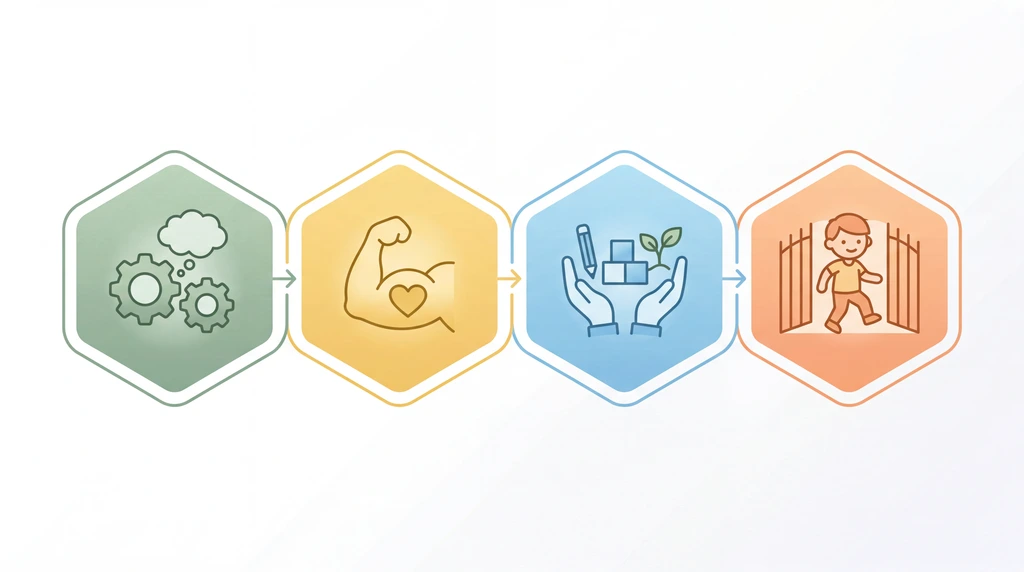
Many parents associate school readiness with letters and numbers. The Hamburg Educational Recommendations emphasize other priorities. They focus on socio-emotional stability. It is helpful if your child can follow a story for a while, dress and undress independently, and endure a conflict without giving up immediately. Children who can handle frustration will find learning to read easier later on.
In the last Kita semester, you can support a lot with everyday things. Let your child walk the school route with you once. Let them pack their lunchbox themselves and pay at the bakery. Talk about school without making it the "serious business of life." Transitions are easier when Kita, parents, and primary school communicate with each other. Observations from the Kita can help teachers get to know your child more quickly.
Kindergarten in Harburg planned: From February 2027, the Stadtküken Kita Glockenturm will open at Neue Straße 44. It is being built in a listed brick church, which will be supplemented by a new wooden floor. Five fixed elementary groups with approximately 20 to 25 children are planned, open Monday to Friday from 7 AM to 5 PM. The Harburg Rathaus S-Bahn station (S3, S5) is about a five-minute walk away, also convenient for families from Heimfeld, Eißendorf, Wilstorf, or Neuland. Questions can be answered by Sara Jakimovski, phone 0151 112 180 32, or you can directly submit a place inquiry.
Conclusion: Three Years That Are More Than Just Waiting for School
Kindergarten has its own value. At three, it's about settling in; at four, about co-creating; at four and a half, the first formal appointment at primary school takes place; at five, you choose the preschool path; and at six, inner strength is what matters most. If you know the Hamburg deadlines and seek dialogue with the Kita, you can make every decision calmly. The planned Stadtküken Kita Glockenturm focuses on nature, mindfulness, and co-creation. You can arrange a personal consultation appointment via our homepage.
FAQ
From when is my child considered to be in elementary education in Hamburg? At three years old, they transition from the nursery to elementary education. This phase lasts until school enrollment.
Does my child have to attend a preschool class in Hamburg? Only if a significant need for language support is identified during the presentation procedure for four-and-a-half-year-olds. In exceptional cases, additional language support in the Kita can replace this obligation if you apply for it and the Kita can offer it. Otherwise, the preschool class is voluntary.
When do I register my child for preschool class? Usually between early November and late January, most easily directly during the presentation interview at the responsible primary school. The exact dates are set anew by the school authority each year.
How long is a day in preschool class? Typically five hours in the morning, usually from 8 AM to 1 PM. Full-day care is possible afterwards.
What happens to the Kita place if my child moves to a preschool class? You must terminate the Kita care contract within the notice period. Therefore, clarify the notice period with your facility early on.
Does my child need to be able to read and write before school? No. More important are independence, listening, and handling conflicts. Letters and numbers will be learned in school.
Note: This guide provides a general overview of the kindergarten years in Hamburg. For your child's specific situation, please contact your Kita, the responsible primary school, or the district office.
👤 About the Author
Arianne Vogt writes for the Stadtküken editorial team about early childhood education. She translates rules, deadlines, and pedagogical concepts into understandable guidance for families.
Sources
- Hamburger Bildungsempfehlungen für die Bildung und Erziehung von Kindern in Tageseinrichtungen (Hamburg Educational Recommendations for the Education and Upbringing of Children in Daycare Facilities) (Authority for Labor, Social Affairs, Family and Integration)
- Rahmenvorgaben für die Vorschularbeit im Brückenjahr (Framework Guidelines for Preschool Work in the Bridging Year) (Authority for School and Vocational Education Hamburg)
- Hamburgisches Schulgesetz, § 28a (Hamburg School Law, § 28a)
- Bezirksamt Harburg (Kita-Gutschein) (Harburg District Office (Kita Voucher))