Kita Acclimatization in Harburg: Your Guide for the First Six Weeks
 Arianne Vogt
Kita Acclimatization in Harburg: Your Guide for the First Six Weeks
Good acclimatization primarily needs time: Plan for four to six weeks, during which your child sets the pace. This timeline shows you what happens in each phase and how you can react if things stall.
Briefly explained: During acclimatization, your child learns to trust a new professional enough to be comforted by them. You initially stay by their side and gradually withdraw. Whether you live in Harburg, Heimfeld, or Wilstorf, whether your child is starting nursery or elementary school: The process usually follows a fixed model. However, it always adapts to your child, not the calendar.
Before it starts: What should you clarify in the weeks prior?
The most important preparation doesn't happen at the Kita, but at your home and with your employer. Block out four to six weeks during which you can be flexible. This can be through vacation, flex time, home office, or reducing overtime. Especially in the first few weeks, children often get sick, so extra buffer time is worthwhile.
As parents, discuss who will take which days and who will step in if your child suddenly gets a fever. It's also sensible to have a consistent accompanying person for the first few days so your child doesn't constantly have to switch between different faces.
Pack a transitional object together, something familiar from home like a favorite cuddly toy or a comfort blanket. This provides your child with security in the unfamiliar environment. If the Kita spends a lot of time outdoors, you'll also need weatherproof clothing. Mud pants and rubber boots aren't just for the child then.
Before the first day, there will be a meeting with the professional who will be accompanying your child. Tell them how your child falls asleep, what comforts them, and which rituals are important to you. This lays the foundation for a true educational partnership. If the formalities are still open: How the Kita-Gutschein (Kita voucher) works at the Bezirksamt Harburg (Harburg district office) can be read in our article on the Kita-Gutschein in Harburg.
Practice a short farewell ritual at home, for example, waving at the window or a fixed phrase like "I'll pick you up after lunch." A ritual your child knows will help them through the first separation later. Further suggestions can be found in the 7 tips for a gentle Kita acclimatization.
Which model underpins the process?
Most Kitas work according to one of the two well-known models or a variation thereof. Feel free to ask during the introductory meeting which one applies to your Kita.
| Model | What it's about | What you'll notice |
|---|---|---|
| Berlin Model | Your child builds a bond with a consistent primary caregiver | Clear phases, separation times are based on your child's reactions |
| Munich Model | Your child is integrated into the whole group early on | Contact with other children is more central from the start |
| Nature-oriented variant | Structure usually follows the Berlin Model, supplemented by lots of time outdoors | First encounters often take place outdoors, where it's quieter than in the group room |
At Stadtküken, nature plays a central role. It's less noisy and less crowded outdoors, and curiosity arises almost naturally. For the planned Stadtküken Kita Glockenturm at Neue Straße 44, a sheltered courtyard and outdoor areas with old trees are planned. The Kita is scheduled to open in February 2027.
Week 1: How do you spend the first days at the Kita?
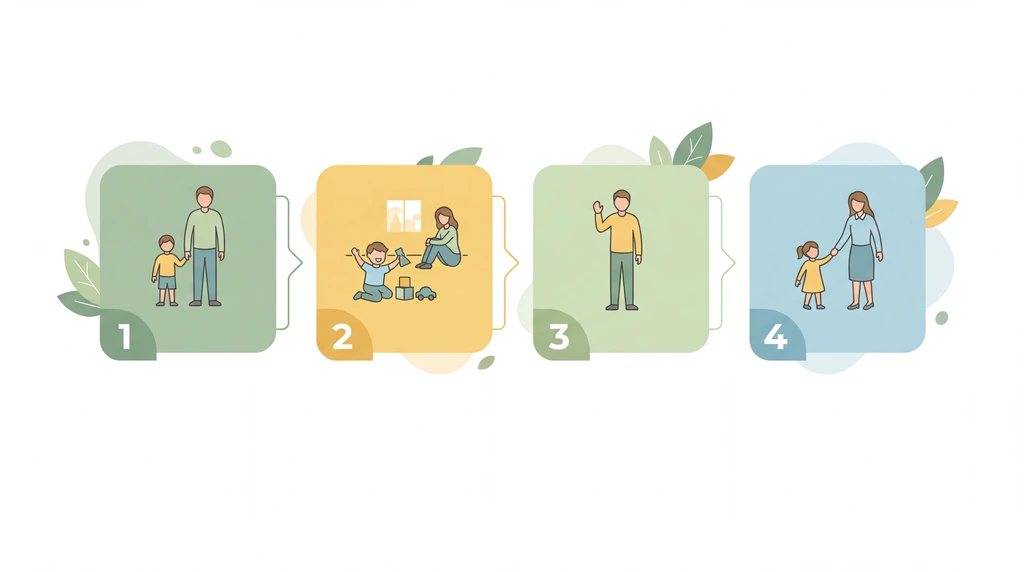
Day 1 to 3: being present, without playing along
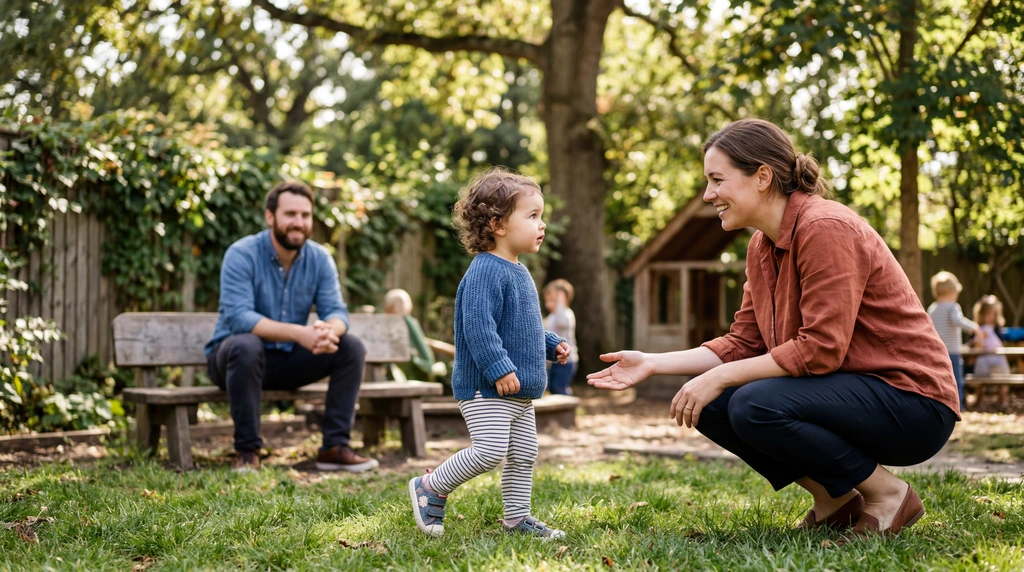
For the first three days, you stay with your child in the group for one to two hours. Find a fixed spot on the side, on a bench, a chair, or in the courtyard. From there, your child can explore and return to you at any time. Professionally, this is called the "secure base."
This sounds simple, but for many parents, it's the most difficult task of the entire acclimatization. You shouldn't encourage your child to play or push them towards other children. The professional initiates the first contact. Take a magazine with you or just observe kindly. If your child spends the entire hour on your lap, that's not a setback, but part of the settling-in process.
Day 4 or 5: the first short separation
At the earliest on the fourth or fifth day, you leave the room for the first time. This separation lasts only 10 to 30 minutes and never falls on a Monday, because the weekend brings many children closer to their families again. Say goodbye briefly and clearly, even if it's difficult for you. If you sneak away or prolong the farewell, it's more likely to unsettle your child.
How your child reacts to this first farewell will determine the next few weeks. If they can be comforted by the professional, things will progress more quickly. If they urgently need you back, the separation will be interrupted and carefully reattempted the next day.
Weeks 2 to 6: When does the time without you increase?
Stabilization
In this phase, the time without you gradually extends. How quickly this happens depends solely on how secure your child feels with their new primary caregiver. There are no fixed numbers for this. Some children adjust after a few days, others need significantly longer. A busy weekend or a cold can delay the process. This is also normal.
Tears at farewell are often part of it. Whether acclimatization is successful isn't determined by whether your child cries. What's crucial is whether they can then be comforted by the professional. Ask when you pick them up how long it took. This feedback tells you more than any smile at the door.
The Final Phase
Eventually, you no longer stay in the facility, but you are always reachable by phone. Therefore, don't plan any important appointments during this time where you have to turn off your phone. The professional has now become your child's reliable base. At Kita Glockenturm, fixed groups are planned, with a maximum of 15 children in the nursery. This is intended to make it easier for the youngest to find familiar faces.
If you are still considering whether a Kita or a childminder is better for your child, our comparison Kita or Childminder in Harburg can help you.
The most common reason for setbacks is external time pressure. If you have to shorten the acclimatization due to a professional appointment, it can undo much of what has grown in your child in the weeks before. Therefore, clarify your flexibility before you start, not in the middle of it.
What helps if things get stuck?
Not every acclimatization proceeds smoothly. These situations are common:
- Your child cannot be comforted at all: In this case, the separation is interrupted, and you take a step back together. Often, the phase where you are present is extended. This allows the relationship with the professional to grow without the pressure of separation. This is not a failure, but an adjusted pace.
- After an illness, everything feels new again: After a few days at home, many children need more support again. Discuss with the professional whether you should start the process a little earlier for a few days.
- You yourself can barely endure the farewell: Watching and letting go is very stressful for many parents. Be open about it. A brief chat when picking up or a call in between can relieve you. Your child senses whether you trust the new place.
- Mondays are harder than Fridays: After the weekend, many children need a little longer. On Mondays, plan for shorter times and no new separation experiments.
In all cases, it helps to stay in communication. You both want your child to feel comfortable, and the professional sees things you don't notice from the door.
Conclusion: Patience is the best preparation
Acclimatization proceeds like a timeline with fixed stations, but your child determines how quickly you progress. If you allow yourself enough time, stay quietly on the sidelines at the beginning, say goodbye briefly, and talk to the professional about any setbacks, you create the best conditions. For many families in Harburg, these first few weeks mark the beginning of a long Kita period. It's worth approaching it calmly. You can find out more about the planned Stadtküken Kita Glockenturm and its pedagogical concept on our homepage.
FAQ
How long should I plan for acclimatization? Count on four to six weeks and also plan for extra buffer time for sick days, which are common at the beginning.
Why does the first separation never happen on a Monday? After the weekend, your child is more attuned to the family again. Therefore, the first separation is planned at the earliest on the fourth or fifth day and never on a Monday.
Am I allowed to play with my child while I'm sitting in the group? It's better to hold back. You are the place your child can return to; the professional should initiate contact for playing.
Is it a bad sign if my child cries when saying goodbye? No, crying is a healthy reaction to separation. What's important is whether they can then be comforted by their primary caregiver.
When can I inquire about a spot at Kita Glockenturm? The Kita is scheduled to open in Harburg in February 2027. For questions, Sara Jakimovski from the Kita placement counseling can help you at 0151 112 180 32 or betreuungsvertrag@stadtkueken.de. You can submit a placement request via https://stadtkueken.de/?popup=anmelden.
Where can I find an overview of Kitas in the district? In our article on Kita in Harburg, we have summarized what you should look for when searching.
Note: This guide provides a general overview and cannot replace a personal conversation with your Kita or a professional consultation. Every child and every family has unique circumstances.
👤 About the Author
Arianne Vogt works in the Stadtküken editorial team, writing about early childhood education. She prepares specialized knowledge in a way that parents can directly use in their daily lives.
Sources
- infans (Institute for Applied Socialization Research / Early Childhood e.V.) – Berlin Acclimatization Model
- State Institute for Early Childhood Education (IFP) – Attachment Theory and Munich Acclimatization Model
- Bezirksamt Harburg – Kita-Gutschein