Finding a Kita in Harburg: How to Find the Right Spot for Your Child
 Arianne Vogt
Finding a Kita in Harburg: How to Find the Right Spot for Your Child

In Harburg and its neighboring districts, you'll find Kitas from various providers and with diverse educational approaches. By applying for a Kita-Gutschein (Kita voucher) early, setting clear priorities, and asking a few targeted questions during your visit, you'll find the spot that suits your child faster.
In brief: If you're looking for a childcare spot in southern Hamburg, you need two things: a Kita-Gutschein from the Bezirksamt Harburg and a facility that fits your family's daily life. The voucher handles the financing; you choose the Kita yourself. This guide explains the types of Kitas available, how to compare them, and the best order of steps to take.
Perhaps you've just found out you're pregnant. Perhaps your parental leave ends in a few months. In both cases, the same question eventually arises: Where will my child spend a large part of their days in the future? The good news: You have genuine freedom of choice in Hamburg. The slightly more challenging news: This freedom also means you have to take care of things yourself.
What Kitas are available in Harburg and the surrounding area?
Hamburg finances childcare through the Kita-Gutschein. This allows many different providers to operate Kitas, including small parent initiatives, church-affiliated facilities, and larger independent providers. For you, this means the voucher is valid at any Hamburg Kita, regardless of who operates it. So, you're not tied to the closest facility. A Kita in Heimfeld, Eißendorf, Wilstorf, or Neuland could be just as suitable as one directly in the center of Harburg.
Roughly, three types can be distinguished:
| Kita Type | How daily life often looks | Suits well if … | Ask specifically about |
|---|---|---|---|
| Kita in the residential area | Fixed routines, playground and group rooms, short distances | proximity to home is your top priority | group size, staffing levels, concept |
| Forest or Nature Kita | Children are outdoors almost all day, in any weather | your child enjoys being outdoors and you can organize weather-appropriate clothing | shelter, drop-off and pick-up locations, equipment |
| Kita with an educational focus | For example, nature, mindfulness, or child participation as a guiding principle | a specific approach is particularly important to you | how the focus is concretely implemented in the daily routine |
None of these forms is automatically better. What matters is what works for your child and your daily life. If you're still weighing Kita versus childminder care, you'll find a comparison here: Kita or childminder in Harburg.
What really matters when choosing?
A beautiful garden and freshly painted walls are pleasant. But for your child, the people and the daily routine are what truly count. These points will help you compare:
- Daily commute: How long does it take you in the morning with a stroller or bike? Is the Kita on your way to work or the S-Bahn? A ten-minute detour sounds minor, but you'll do it twice a day.
- Opening and core hours: Do the hours fit your working hours? Is there a core time when your child should be present?
- Staff and groups: How many educators care for how many children? Ask about the staff-to-child ratio and how the Kita handles staff absences.
- Making quality visible: How does the facility review its work? Feel free to ask what quality monitor or process they use.
- Settling-in period (Eingewöhnung): How much time does your child get to settle in? Are you allowed to be present at the beginning? You can read more about this in the article on settling into Kita.
- Parent collaboration: How do you find out how your child's day was? Are there development talks, parent evenings, or a parent app?
- Costs beyond the voucher: Some Kitas ask for voluntary additional payments, for example, for organic food. Read the contract carefully.
Bring a small note with three questions that are most important to you to the information evening or consultation. For example: "What does a typical morning look like?", "What happens if my child cries a lot during the settling-in period?", and "How often do the children go outside?" When listening to the answers, focus less on perfect phrasing and more on whether you can imagine your child thriving there.
How do you get a Kita spot step by step?
Most families underestimate not the search itself, but the lead time required. Here's the best way to proceed:
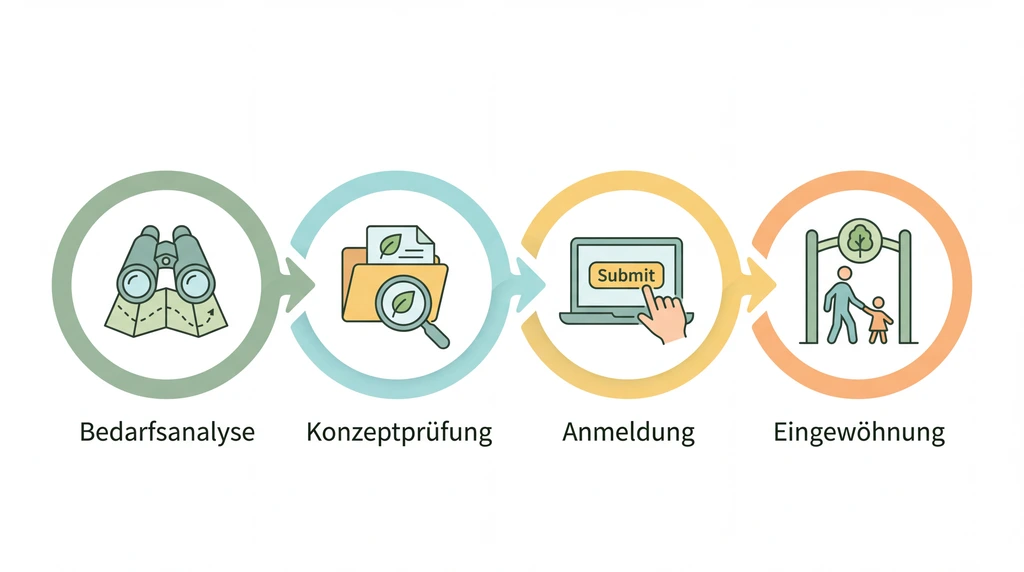
1. Clarify your needs. From when do you need childcare, and for how many hours a day? What educational approach is important to you? What is a realistic commute?
2. Find and compare Kitas. The Kita Information System of the City of Hamburg provides an overview of facilities. You can also filter by focus areas there. Make a note of the Kitas that appeal to you and use information events or consultation appointments.
3. Register early. Kitas with a special profile are particularly in demand. Many families put their names on waiting lists during pregnancy.
4. Apply for the Kita-Gutschein. If you live in Harburg or the surrounding districts, you apply to the Bezirksamt Harburg. All details about the application and required documents can be found in the article on the Kita-Gutschein in Harburg.
5. Contract and settling-in period. Once you have an offer, you sign the childcare contract. After that, the settling-in period (Eingewöhnung) begins, during which your child gradually builds trust with their new caregivers.
Without a valid Kita-Gutschein, your child cannot attend a Hamburg Kita. You can submit the initial application no earlier than twelve months before the desired start of care, and three to six months beforehand is recommended. Funding begins no earlier than the day your application is received by the Bezirksamt. Nothing will be paid retroactively.
What does a Kita spot cost in Hamburg?
The first five hours of daily care are free of charge, including lunch. If you need more hours, you pay a parent contribution, which is based on your income.
For your planning, it's worth looking ahead: The Senate has decided to re-regulate parent contributions. However, the legal ordinance with the final contribution tables is not yet available. What is known so far:
- The five free hours remain.
- Contributions will not change until July 31, 2027.
- The maximum contribution will increase from 191 Euros to 320 Euros on August 1, 2027, and to 336 Euros on August 1, 2028.
- Families with lower incomes will be relieved: For a two-person household, a contribution will only be due from a net income of 2,650 Euros per month, whereas previously the limit was 1,023 Euros.
You can estimate your approximate contribution with the Kita-Gutschein calculator. It is based on Hamburg's fee schedule.
What is planned for the Stadtküken Kita Glockenturm in Harburg?
From February 2027, a new facility is set to open at Neue Straße 44: the Stadtküken Kita Glockenturm. It is being built in a listed brick church, which will receive an additional floor constructed in wood. This includes a sheltered courtyard and outdoor areas with old trees.
Around 170 spots are planned for children aged 0 to 6, divided into six nursery groups (Krippengruppen) with a maximum of 15 children and five elementary groups (Elementargruppen) with approximately 20 to 25 children. The groups will be fixed to ensure children have reliable caregivers. The Kita will be open Monday to Friday from 7 AM to 5 PM, with core hours between 9 AM and 2 PM. Pedagogically, Stadtküken focuses on nature, mindfulness, and co-creation. The Kita-Gutschein will be accepted.
Practically for daily life: The Harburg Rathaus S-Bahn station (S3 and S5) is about a five-minute walk away, and Harburg City Park is within reach for excursions.
Since the Kita is still under construction, initial meetings and consultations will take place through discussions. The contact person for Kita spot consultation is Sara Jakimovski, reachable by phone at 0151 112 180 32 or by email at betreuungsvertrag@stadtkueken.de. You can arrange a consultation appointment via the Stadtküken homepage, and submit a spot inquiry directly via the registration form.
Conclusion: Start early, compare honestly, stay calm
The Kita search often feels bigger at first than it actually is. If you know your needs, apply for the voucher in good time, and register your interest with several facilities, you've already completed the most important steps. Compare Kitas based on what matters in everyday life: reliable caregivers, a gentle settling-in period, good commutes, and an approach that suits your family. And trust your gut feeling. It's often a good indicator of where your child will feel comfortable.
FAQ
When should I start looking for a Kita in Harburg? As early as possible. For popular Kitas with a special profile, many families register their interest during pregnancy. You can apply for the Kita-Gutschein no earlier than twelve months before the start of care, ideally three to six months beforehand.
Where do I apply for the Kita-Gutschein? If you live in the Harburg district, the Bezirksamt Harburg is responsible for you. Important: Funding begins no earlier than the day your application is received there.
Do I have to choose a Kita in my district? No. The voucher is valid at all Hamburg Kitas. So you can also choose a facility in a neighboring district if it better suits your commute or your preferences.
Is a Kita spot in Hamburg free? Five hours daily, including lunch, are free of charge. For additional hours, you pay an income-dependent contribution. From August 1, 2027, the contributions will change, but the exact tables are still pending.
When can my child attend the Stadtküken Kita Glockenturm? The opening is planned for February 2027. Children aged 0 to 6 are expected to be admitted. You can submit a spot inquiry now.
What should I ask during the first meeting with a Kita? Ask about the daily routine, group size, staff-to-child ratio, the settling-in process, and any additional costs. This will quickly give you a realistic picture.
Note: This article is intended to provide you with an initial overview and cannot replace a personal conversation with the Bezirksamt or the Kita of your choice. The current regulations of the City of Hamburg are always binding.
👤 About the Author
Arianne Vogt writes for the Stadtküken editorial team and focuses on questions related to early childhood education and daily Kita life. Her aim is to provide parents with understandable and practical information.
Sources
- Hamburg Childcare Act (KibeG)
- Hamburg Educational Recommendations for the Education and Upbringing of Children in Daycare Facilities
- Bezirksamt Harburg, Kita-Gutschein
- hamburg.de, Kita Information System